


inspectorreuben
-
Posts
68 -
Joined
-
Last visited
Content Type
Profiles
Forums
Articles
News for Home Inspectors
Blogs
Gallery
Store
Downloads
Posts posted by inspectorreuben
-
-
Jerry - yeah, I know

Bob - I think you're on to what I'm after, which is the reasoning behind the code.
If someone else has a great explanation of why, I'd be interested to hear. I hate telling my client "you can't do this because it's code." Instead, I said it wasn't safe... but I really don't know why, and come to think of it, I guess I'm really not sure it isn't safe.
-
Why can't a wood stove and a natural gas water heater share the same vent?
-
Thanks Jim and John. Good info.
-
I agree with the Mickey Mouse part, but what makes this dangerous?
- Reuben
I've a few thoughts but am more interested in what you think makes it dangerous Reuben.
The two laterals are at angles to each other. They sway in the wind differently, makes them rub and wear away at the insulation. Dangerous indeed.
Marc
Ok, I can dig it. It looks like it's been this way for a while though, and I didn't notice any damage to the insulation.
- Reuben
-
I agree with the Mickey Mouse part, but what makes this dangerous?
- Reuben
I've a few thoughts but am more interested in what you think makes it dangerous Reuben.
John Kogel is the one who said it was dangerous, not me. I'm also interested in what makes this dangerous.
-
Mr Handy may be supplying his garage with 120 volts using the 2 insulated cables.
Correct. One of the insulated cables was a grounded conductor, and the other was an ungrounded conductor.
Was there a ground rod for the service in the garage?
Yes.
I suspect the entire hookup is Mickey Mouse and dangerous.
I agree with the Mickey Mouse part, but what makes this dangerous?
- Reuben
-
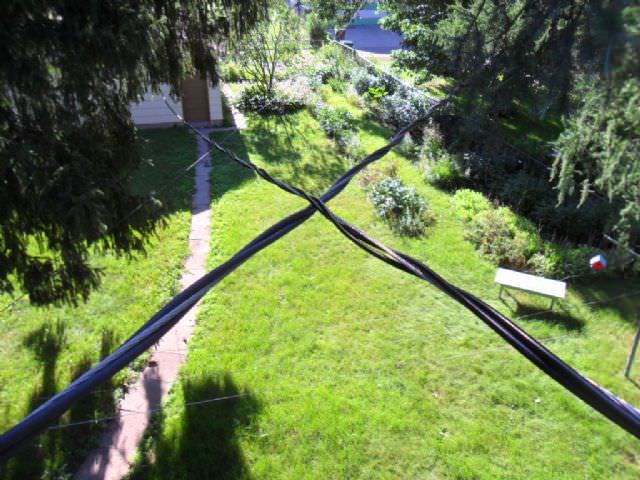
I'm scratching my head on this one. The overhead conductors that supply power to the garage are actually in contact with the service drop, which I'm sure can't be right... but I don't know where to find a reference for this.
Also, the bare aluminum wire that runs to the garage isn't a conductor; it's just being used to support the other two conductors. Shouldn't it at least be bonded?
Click to Enlarge
82.79 KB
-
I watched the video, but it was only about cleaning with alcohol.
Is there another video for repairing the switch?
No. The switch on my flashlight would only get the light to turn on about one out of five clicks, so I assumed it was a bad switch.
After giving everything a thorough cleaning with alcohol, my switch magically started working 100% of the time.
Magic I tell you.
- Reuben
-
I'm the one that quoted that axiom. This is what I was told when I submitted my first fifty reports to ASHI for verification so I could use their logo. My reports got longer.
I was told this again when I submitted my next 250 reports for full member status, as there were still several items that I didn't include in my reports. My reports got longer still, and they've stayed that way.
The other inspectors in my company had similar experiences when they submitted reports to ASHI for verification.
After reading this thread, I'm starting to think that many of the ASHI report verifiers don't know what they're talking about and that I've wasted hundreds of hours reporting on crap that nobody cares about.
Good times.
- Reuben
-
I feel like a bit of a dope saying this, but the switch on my TK11 wasn't really bad, even though I was positive it was.
I watched the cleaning video on the Fenix web site and followed the instructions, and now the switch on my flashlight works perfectly. Nice.
-
If anyone's interested in swapping a recent sanitized report for a 'no holds barred', constructive and thorough critique on writing style, format, etc, pls let me know.
Marc
I'll take you up on that.
- Reuben
-
If you're concerned about someone getting hurt, you could recommend they coat the windows with http://www.3m.com/product/information/Scotchshield-Ultra-Safety-Security-Window-Film.html.
- Reuben
-
By-the-way, if you look closely at the photo in my original post, you can see that the side combustion air port on the furnace cabinet has been used, but that the installer never sealed the optional top combustion air port.
Good point - I didn't notice that.
- Reuben
-
Because you can "take all combustion air from outside" via ducts, via holes through an exterior wall, etc., and still not be a direct vent appliance. The key to that definition isn't "takes all air from outside" but "sealed combustion chamber that draws all air for combustion from outside." That's not what you said; you might have meant that, but that's not what you said.
Ok... I'll try to choose my words a little more carefully.
- Reuben
-
No, that's not accurate at all and it's liable to confuse some rookies. You can have an inner room containing appliances with air ducted to that room from the outside; however, unless the appliance is a direct-vent type, even though those appliances get all of their combustion air from the outside via those ducts, it does not make those "direct-vent" appliances.That's not how I interpret that particular cite. You need a solid, weather stripped door for a natural draft WH installed in a bedroom closet. You don't need it for a direct vent WH in the same location. Can't put either in a storage closet.Marc
There are natural draft water heaters that have thru-floor ducting-all combustion air is drawn from outside. Closet locations are closed with a panel, sans weather stripping. Of course I'm referring to HUD Code country.
If it takes all of it's combustion air from the exterior, it's a direct vent water heater.
- Reuben
In the situation you're describing, the appliance isn't getting all of it's combustion air from the outside; it's getting it's combustion air from the room it's in.
The definition of a direct-vent appliance, from the 2006 IRC is:
A fuel-burning appliance with a sealed combustion system that draws all air for combustion from the outside atmosphere and discharges all flue gases to the outside atmosphere.
I wrote "If it takes all of it's combustion air from the exterior, it's a direct vent water heater."
How is this not accurate at all?
- Reuben
-
That's not how I interpret that particular cite. You need a solid, weather stripped door for a natural draft WH installed in a bedroom closet. You don't need it for a direct vent WH in the same location. Can't put either in a storage closet.
Marc
There are natural draft water heaters that have thru-floor ducting-all combustion air is drawn from outside. Closet locations are closed with a panel, sans weather stripping. Of course I'm referring to HUD Code country.
If it takes all of it's combustion air from the exterior, it's a direct vent water heater.
- Reuben
-
Other: I'm still looking for more opinions regarding the downhill vertical run of the exhaust vent. Does anyone have any documentation spelling out that this is not allowed? I've only seen this specifically spelled out as not allowed in a direct vent water heater installation manual.
If you read the installation instructions and this wasn't prohibited, why are you worried? I don't think anyone's opinion here makes any difference if the manufacturer doesn't prohibit the installation. Are you thinking the furnace is going to malfunction or create an unsafe condition? If so, call Ruud and ask 'em.
-
Question: Would it have been the responsibility of the furnace installer (2009) to address these issues when he installed the furnace? (same guy installed the CAT I water heater in 2002)
IMO, no. If the furnace guy is being hired to install the furnace, let him install the furnace. He's not there to fix every other defect at the house, even if the defect is very closely related to what he's doing.
Ultimately, it would be up to the AHJ to decide. The AHJ needs to have a bit of a balance in what they decide to make contractors do; while it would be nice for the safety of the occupants for the AHJ to require correction of all installation defects they see that relate to the trade they're inspecting for, they're overstepping their bounds if they do this.
When AHJs start making contractors fix other stuff that isn't directly related to the work that's being performed, contractors will start becoming reluctant to pull permits. A good AHJ will recognize this and not overstep their boundaries.
- Reuben
-
G2406.2- (Exception 5)
This basically states a direct vent appliance installed in a bedroom closet needs a solid, weather-stripped door with a self closer and all combustion air must be obtained from the outside..
I don't have the 2009 IRC, but in the 2006 IRC it says you can have an appliance located in one of those prohibited locations if the installation complies with one of the following, and then goes on to list the exceptions.
The first exception listed is a direct vent appliance. This means that if you have a direct vent appliance, you don't need to do anything special. You can put it wherever you want, and you don't need to mess around with weather stripped doors and all that. Those requirements are only for non-direct vent appliances.
Did they change this in the 2009 version?
-
I wouldn't worry about the vent going up or down, as long as it does one of the two and condensation doesn't discharge to an objectionable location. The manufacturers just don't want there to be a place in the vent where the condensate will collect.
- Reuben
-
. . . with spacers.jpg[/img]
38.79 KB
Can you imagine anyone actually doing that?
Download Attachment:
WellBoltedLedger.JPG88.58 KB
[:-thumbu]
-
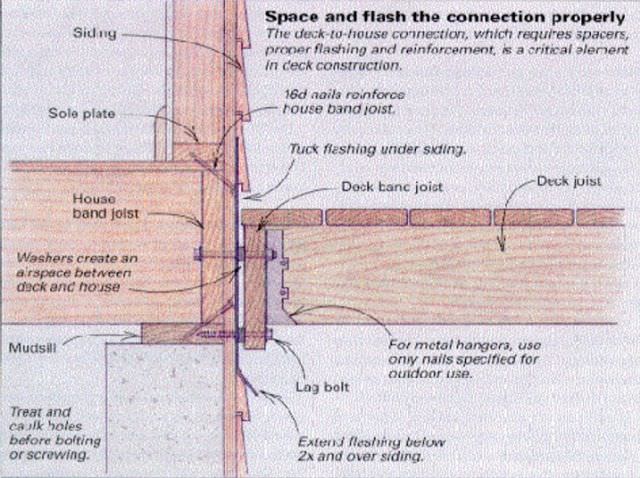
While we're on this topic, what's a good way to keep water from leaking in where one piece of flashing ends and the next begins?
Click to Enlarge
28.16 KB
- Reuben
-
Thanks for the replies, everyone.
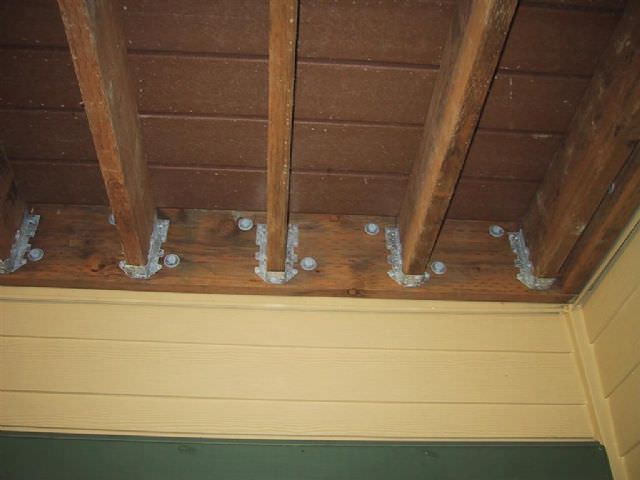
I'd have used coil stock behind the whole thing and spacers like below.
Click to Enlarge
79.86 KB
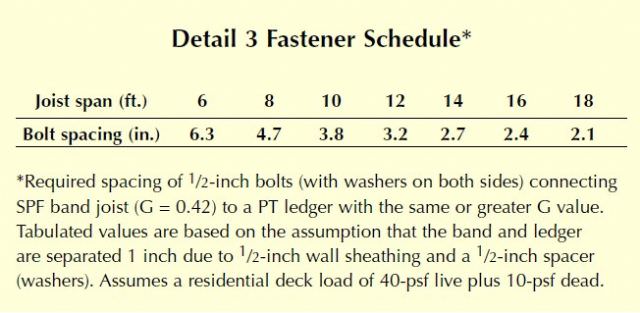
In the August '03 issue of the JLC, they discuss using spacers like you showed above. They basically said this is a practice that should be avoided, but if you're going to do it, use the following fastener schedule:
Click to Enlarge
38.79 KB
Can you imagine anyone actually doing that?
- Reuben
-
What's it look like topside?
There wasn't much to see.
Click to Enlarge
38.25 KB
- Reuben


Split Face Block Chicago - What to do?
in News Around The Net
Posted
By "test" I meant doing something like Kurt did in the video he posted. Drill a hole in the wall and have water pour out, or something like that.