Jerry Simon
-
Posts
1,562 -
Joined
-
Last visited
1 Follower

Jerry Simon's Achievements

Senior Member (4/5)
92
Reputation
-
Yeah, in about so many words. Zinsco electrical panels are inherently dangerous. Have the panel replaced ASAP.
-
-
About five years ago. Don't recall timing of such related to cracking appearance, though. That said: Above half the crack-affected area is my master bedroom, and I had carpet removed and hardwood flooring installed in the bedroom a couple years after the drywall went in. Thinking that could have easily caused the cracking (though may not explain why cracks run entire length of ceiling instead of just below the bedroom area).
-
More than just cracks; big-a** splits I should have said. And, this is just half of the basement ceiling; steel beam divides room in half, and cracks are only on the one, same-size half (room is about 27 x 27). Would like to fault contractor, but seeing above, hard to make that case. Pretty sure I'm missing something, though.
-
My drywalled basement ceiling, approx. 27' x 13', applied to TJI ceiling trusses (upper and lower rails separated by OSB). Two drywall seam cracks, four feet apart, running entire 27' length of room, cracks perpendicular to trusses. Zero noticeable flex to floor, and minimal live loads above, and minimal dead loads, biggest being a refrigerator at middle third of span. I could see having these cracks if they were running parallel to the trusses, where just a couple flexing trusses could cause cracks, but hard to envision cracks running entire 27' length of room when cracks are perpendicular to trusses. In my mind, it would mean almost each and every truss would need to flex, more than a little, to cause such cracks. Any thoughts at what else might cause these two, four-feet-apart, parallel seam cracks aside from truss flexing? Could just one, or a couple/few, flexing trusses cause such cracking across entire 27' ceiling span?
-
Yes, please, else I won't be able to sleep tonight. . .
-
Sounds like it may be AI generated.
-
Like I said; call a roofer.
-
You may certainly be correct, but didn't look like EIFS texture to me; more like a hardboard stucco. (If so, shouldn't be the sole area with issues.)
-
Last picture suggests a wall-roof flashing leak above (though a picture of the wall/roof juncture area above would help here). Have a roofing contractor check.
-
A shout-out to Moen. Talked with their warranty dept., and they're sending me replacement cartridges, a replacement tub spout (as aerator ring may also be deteriorating), and a cartridge removal tool, all FREE of charge (others are selling removal tool alone on-line for $24.00 or so)! Spent maybe 5 minutes total on the phone with service person. Made my day.
-
Yeah, I'm thinking O-rings also. After messing with water heater and the faucet valves, a couple bigger chunkers of black stuff came out the hot side. I did unscrew that plastic stem, and it was an extension of the cartridge's top stem. Cartridge was being held down by a plastic ring which screwed down the inside of the threaded tube (tube threaded inside & out). Once I got the ring out, seemed to be a matter of simply pulling the cartridge up and out. Wouldn't budge though with a needle nose, and not wanting to risk mangling the top of the cartridge's plastic stem any more than I already had, I gave up. Don't want to risk cartridge damage until I have a new compatible one onsite. Any thoughts on pulling a stubborn cartridge? (Plumbers are so darn expensive, but might be time. . .)
-
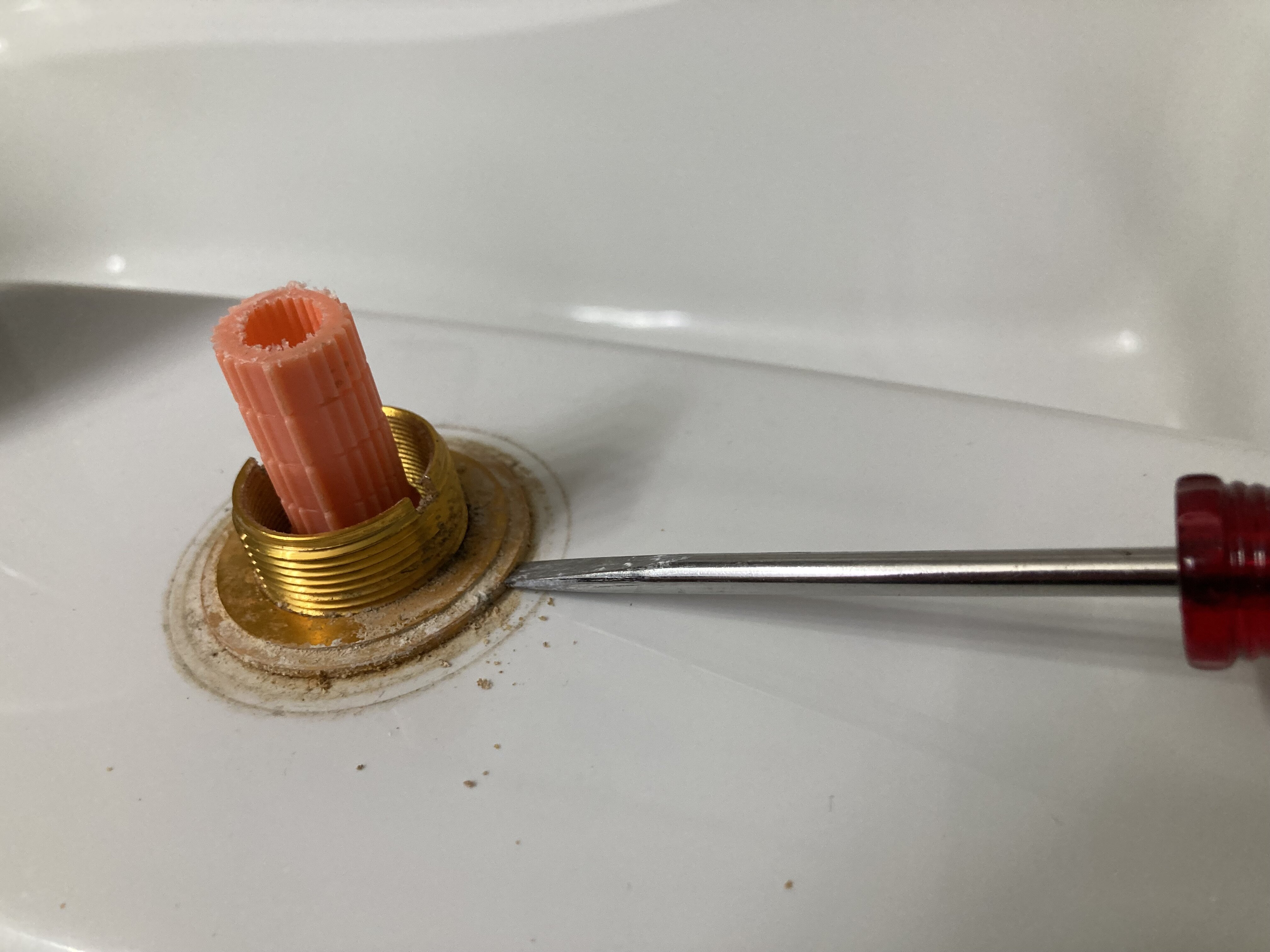
I've got these tiny, pinhead size black specs/residue on my white acrylic bathtub surface after use. When I wipe them off, they smear like tar. I believe it's some sort of deteriorating rubber residue from a pipe or a faucet, or perhaps my water heater. Bled my water heater, and no sign of residue. Unless/until I get some other good advice, hopefully here, I'm going to replace the tub faucet cartridges where perhaps their deteriorating O-rings are the culprit. Having trouble, though, knowing how to pull the cartridges; unlike others I've done. Two handle tub faucet, and once the handle is removed, I've got a notched, threaded tube, and same has a metal base ring that appears to be threaded onto the notched tube. Pinkish stem sticks up the middle. Inside the pinkish stem is a phillips head screw. How do I proceed? Screw removal and simply pull the cartridge (doesn't seem right. . .)? Unscrew the notched tube? Unscrew the tube's base ring (the one the screwdriver in the picture is pointing to)? Any and all help is welcome, and any other thoughts on what might be the source of tub surface residue. Happens every time tub is used, but only in past few months. Water heater is only about two years old, though I read the sacrificial anode might be the culprit? Water heater is piped with copper, not flex. Thanks for any help.

-
How to access non-screw outside plumbing access panel
Jerry Simon replied to Wolverine's topic in Plumbing Forum
Get permission to pry it open (looks like someone already did such along the bottom). May very well be a nail. -
Nate found out it was true; most new home inspectors don't last long in this biz.