

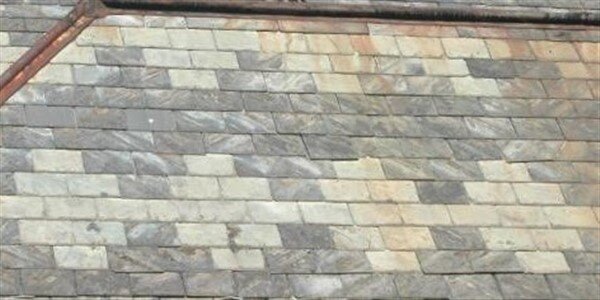
In my experience, many folks are getting incomplete, incorrect or in some cases, intentionally misleading advice about their slate roofs. This usually leads to either non-professional and temporary repairs, costly unnecessary repairs or replacement of a roof that still has many decades of remaining life. I've found many unfairly condemned slate roofs that could likely last another century and sometimes even more. As a home inspector, I feel it's important to accurately and objectively inform my clients about their roof's type, condition, immediate repairs needed and future maintenance. Here's a few of the most important concerns:
All slate roofs, no matter the type or age, require regular repairs. As the roof gets older, the frequency or amount of the repairs usually increases. It's most important that homeowners find the right contractor with the right knowledge, skills and tools to make those repairs.

Cracked, broken, loose or missing slates need to be regularly replaced. If about a half dozen or less need replacement every year, I'd consider it a typical slate roof in really good condition. The most common attempts at repairs are also the worst. This includes using roofing cement, mastic, adhesive, caulking and even spray-on coatings to patch the surface of gaps that are left exposed when slates have broken or fallen off. These are temporary repairs and it makes it quite difficult to repair it properly later. The individual damaged slates and nails need to be completely removed. It's also important that each replacement slate is very close to the thickness as the rest. The wrong thickness can kick up the slate at adjoining courses, which can then easily break.
The technique used to fasten the new replacement slate is also important. Improper “face nailing” involves punching a hole through the exposed section of a perfectly good new slate, driving a nail through the hole to secure it and smearing some temporary goop over the nail. A competent slate roofer usually secures replacement slates with nails that are completely concealed. Another accepted method is to secure the new slate with a thick-gauge wire hook, however a portion of each hook will be visible. Some hooks however, are only thin-gauge sheet metal, often soft copper, that are not rigid enough, unbend and release the replacement slate.

Some other issues with slate roofs that can cause ongoing serious leaks are from improper installation. The most common is the incorrect overlap of slates at courses. This is called the headlap. Slate roofs are not waterproof. - they shed water. Inadequate headlap can result in water leaking in through the vertical joints between the slates. For most roofs, the headlap should be a minimum of 3 inches. More headlap is needed for lower slopes and a bit less for very steep slopes. Individual replacement slates must be the same size to maintain this headlap.

Some contractors try to justify their improper installation by declaring that headlap is unnecessary because of the presence of asphalt felt paper installed below the slates. That just means they know the installation will fail and the paper below the slates is expected to control the leaks.
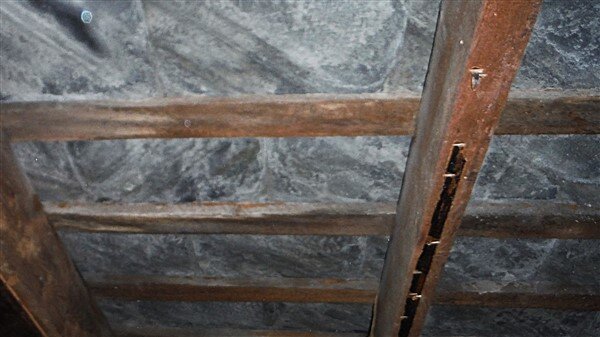
This brings up the persistent folklore about roofing felt under slate roofs. Some insist that felt paper only lasts 50 years, so the slate roof needs to be replaced at that point. A large majority of the thousands of slate roofs I’ve evaluated are installed on spaced wood lath, where it’s clearly visible no felt paper was used, nor is it necessary – except maybe it eliminates the occasional bit of wind-driven snow that enters between slates.
Another issue is improper nailing of slates. If the nail heads are not properly set below the surface of each slate, the protruding nail can pop holes or break the slates in the course above. The slates should have the nail holes punched, from the back, not drilled, to create the proper cone-shaped countersink hole.

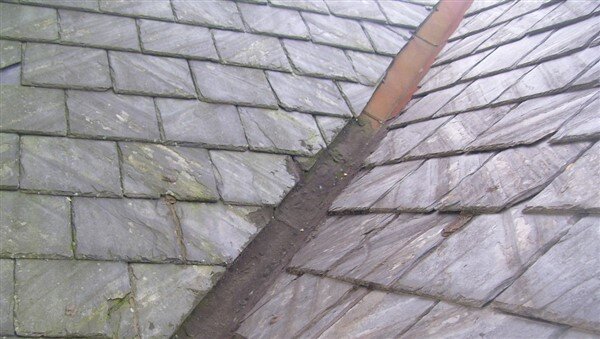
Inspecting the flashing details of a slate roof isn't much different than other types of shingle, tile or shake roofs as they have the same form and function. Old slate roofs often have the original ferrous metal flashings coated with a lead-tin alloy and later painted. The rest usually have copper. With a majority of slate roof systems, the slates outlast the flashings. With slate, flashing failure isn't the end of the roof system. A competent slate roof contractor can replace those flashings by removing and reinstalling the adjacent slates.
These are just a few of the issues with slate roofs. For really detailed information, get the Slate Roof Bible by Expert Joe Jenkins slateroofwarehouse.com/Slate_Bible_3.
COMING SOON - Next: Slate Types & Life Expectancy.
More stuff about old houses can be found at historicbldgs.com.
© 2024 The Inspector's Journal & Bill Kibbel. All Rights Reserved. No written content or images may be reproduced or distributed in any form or stored in a data retrieval system, including datasets used by artificial intelligence.





Recommended Comments
Create an account or sign in to comment
You need to be a member in order to leave a comment
Create an account
Sign up for a new account in our community. It's easy!
Register a new accountSign in
Already have an account? Sign in here.
Sign In Now