Bill Kibbel
-
Posts
4,047 -
Joined
-
Last visited
Content Type
Profiles
Forums
Articles
News for Home Inspectors
Blogs
Gallery
Store
Downloads
Everything posted by Bill Kibbel
-
"Asbestos wrapped" ducts - originally connected to a coal-fired octopus furnace.
-
Plastic slates, aka mud flaps. Curling is very common with the older products. The manufacturers have claimed it's not a defect and is a minor cosmetic issue. A step was added to some installation instructions. The installer should bend each individual slate down at the butt end and corners before installing. I don't think this helped for the long term.
-
Every piece of pressure treated LVL I've seen that us over 10 years old has significant rot. Pressure treating LVL post-manufacture didn't work.
-
Desotoroofers and Rooferscarrollton is the same person - link-dropping.
-

PREMIUM BRAND High Density BUILDING INSULATION
Bill Kibbel replied to emandelcorn's topic in Attics & Insulation
Asphalt coated kraft paper. The coating is on the other side of the paper but some penetrates through. -
1900 Stone Foundation without footings
Bill Kibbel replied to Jean's topic in Foundation Systems Forum
Don't put a footing drain where there's no footing. "Waterproofing" contractors have caused major failures to many stone and brick foundations. I get called in as the expert witness. The clay pipe is for the original gravity drain. It no longer functions as originally intended, but illustrates that the builder expected water in the basement and gave it a path out. https://historicbldgs.com/stonefoundations.html -
Thanks to journalist and author Jim Morrison (whose work has appeared in The Boston Globe, The Boston Business Journal, Forbes.com and hundreds of publications across the country) for the following: FOR IMMEDIATE RELEASE Rochester, NY (January 27, 2020)—Inspector Central is holding its first-ever Home Inspector Road Show March 20-22, 2020 at the iconic Hotel Henry Urban Resort Conference Center in Buffalo, NY This is not a typical home inspector conference. The speakers each have decades of study and field experience. You will leave this conference with practical knowledge you can put to use on your next inspection. But don’t expect three days of dry lectures, these guys like to have a little fun when they’ve got an audience in front of them. The three-day conference offers 24 CEUs and features three nationally-well-known expert home inspectors: Bill Kibbel, Jim Katen and Chad Fabry. The Hotel Henry is a National Historic Landmark just 15 minutes from the airport and a two-hour flight from most major airports in the Northeast. Buffalo is the second-largest city in NY and just 20 miles from Niagara Falls, so your spouse will have plenty to see and do while you’re in class. In fact, you might want to plan to stay an extra day or two (and bring your passport). Don’t scramble to find some locally thrown-together class at the last minute when you license is up for renewal. Spend three days with some seasoned home inspection veterans. You’ll learn a lot, have some laughs, and come home with two years’ worth of CEUs. Add in the war stories you’ll hear being swapped over meals, and there is no better home inspection education value anywhere. Register now and save $78! The course is NY, NJ, PA, MA, MD, VA, ASHI, I-NACHI, and CAHPI-approved accredited continuing education. Inspector Central is the premier multi-state approved education provider for Home Inspection Continuing Education in New York. Owner and lead instructor Chad Fabry has been building, renovating and inspecting residential and commercial buildings since the latter half of the 20th century.
-
I hadn't ever considered that there was a lucrative market for counterfeit thermal insulation. If you suspect he made it in his shed and managed to spray it on, there's a couple ways to check the possibility of it being treated. Take a match to it or see if it helps clear up a yeast infection.
-
Wet-spray cellulose is occasionally used in CMU commercial buildings here. Haven't seen it in a residence yet. Properly applied, it adheres very well. It's borate treated and has a class 1 fire rating. Usually contains a high percentage of recycled material. In these parts, I'd rather see insulation on the foundation and perimeter of the floor structure than between joists.
-
I just go to copper.org and find the copper tubing for fuel gas distribution installation guide. The tubing manufacturers usually refer to that guide.
-
It's quite likely algae. It's common in cooling towers here throughout the summer. The same algae grows in my pond. I don't think that identifying the Latin name of the stuff is as important as proper cleaning, maintenance, shutdown procedure and water treatment. I have specific advice I can send you, if you'd like.
-
Mold Inspectors Needed
Bill Kibbel replied to Brandon Castle's topic in Indoor Air Quality (I.A.Q.) and Mold Forum
Read 'em again. Pay attention to the wording in the sections labeled Advertising and Link Guidelines. -
Sound of water trickling inside radon vent pipe
Bill Kibbel replied to Mike Lamb's topic in Environmental Hazards
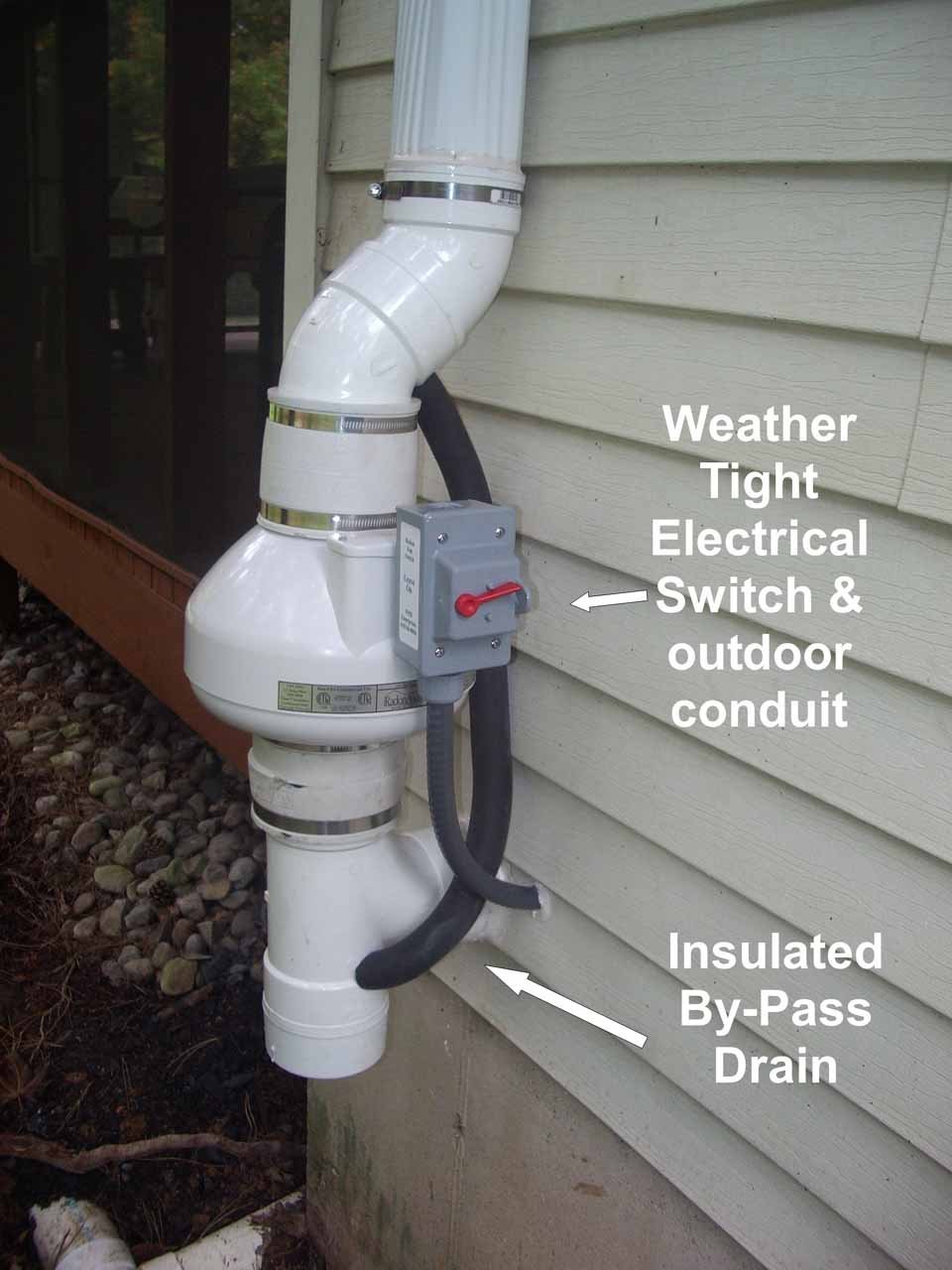
Canada does not require installations meet the US mitigation requirements. In fact, they discourage exterior fan installations and above the roof terminations. They also "suggest" discharge pipe terminations be a minimum of only 30 cm from openings into the building. -
Sound of water trickling inside radon vent pipe
Bill Kibbel replied to Mike Lamb's topic in Environmental Hazards
Some reduction systems' intake pipe is directly connected to the sub-slab drainage piping. Sometimes water is being sucked up and drains back down. It's usually more of a gurgling sound. There's often a tremendous amount if vapor sucked up into the intake. If the exhaust pipe is on the exterior, the vapor condenses during cold weather and drains back down. I have a neighbor who is referred to nationally as the godfather of radon mitigation. His systems include dealing with the condensate:
-
Single Wall Furnace/Water Heater Vent Through Wall To Chimney
Bill Kibbel replied to DPugh's topic in HVAC Forum
The "licensed HVAC person" needs some training. Like a majority of vent connectors I see, it is incorrectly installed. Assuming this is gas-fired equipment: In addition to the 6" clearance to the framing at the wall opening, the same clearance is needed to the wall surface for the entire length of the pipe pictured. 12 feet is too long for a 5" vent connector. I can't see how the furnace and water heater vents are combined into the single, single-walled pipe - it can be done, but it's likely wrong. Get someone competent to correct these issues, check for others and install a B-vent system. They can also install a firestop collar from the vent manufacturer at the wall opening. -
conversion from LP to Nat Gas
Bill Kibbel replied to John Dirks Jr's topic in Fireplaces, Chimneys & Wood Burning Appliances
If I tried converting and fixing something like that, they'd evacuate the entire township. -
There's stone/tile repair kits available just for that type of issue. They're usually between $15 - $20.
-
Could be that the water in the radiator froze - expanded. That type of radiator doesn't have the threaded rods at the top. It doesn't always result in a leak. There are smaller diameter nipples inside those openings that insert into adjacent radiator sections.
- 1 reply
-
- 1
-

-
I don't remember anything from the 80s. Don't want to. I saw a photo recently showing my hair and how I dressed. Did you mean 1880s?
-
The handle is an example of what happens to equipment when it gets old.
-
In my experience, there were 2 types of fiberboard used for backing plaster. One is made from the waste fibers from processing sugarcane. This was the original product of the Celotex Co. The other is made with wood fibers. What's in he picture is likely the latter. The appearance (large, long coated fibers) and building age leads me to think it is Universal Insulite. It was a popular brand.
-
That's fiber-cement roof decking, not insulation. It's made with wood fibers and doesn't contain asbestos.
-
There's mold spores everywhere on the planet. Always was, always will be They're on your skin. They're on your eyeballs. Stop reading bs mold hype from the media, lawyers and mold-is-gold con artists. Worry about real problems or live in a plastic bubble. Sorry, but this mold crap has gone too far.
-
1/2" is just about right for the loom (additional protective sleeve) that enshrouds the single wire.
-
The first pic is definitely k&t.