


Jim Katen
-
Posts
10,287 -
Joined
-
Last visited
Content Type
Profiles
Forums
Articles
News for Home Inspectors
Blogs
Gallery
Store
Downloads
Everything posted by Jim Katen
-
I see that the minimum circuit ampacity is 10 amps . . . though if it's working, I guess that's all you need.
-
Look at the furnace's rating plate - it's almost certainly going to be greater than 7.5 amps. Then just try bonding the grounding terminal to the neutral at the generator - even temporarily as a troubleshooting measure.
-
Awful report. The pictures show a single post that's not centered in its pier block. That's not a big problem, it's not even a little problem. Don't worry about it. I'd be much more concerned about getting that electrical cable up off the ground, installing a vapor barrier on the ground, and installing some seismic retrofitting - if you're in the Bay Area.
-
That's a great question. I didn't even look at the capacity of the generator. Most furnaces are going to need 8-10 amps, not the 7.5 that this one produces. It's possible that the generator just isn't producing enough power.
-
According to the instructions ( https://www.electricgeneratorsdirect.com/manuals/Honda EU1000i Manual 2013.pdf page 38), the equipment grounding wires are bonded to the frame of the generator but not to the neutral. This makes little sense because the EGCs will never clear a fault that way. This also explains why your furnace won't work while connected to it. The instructions don't mention it, but there should be a bonding strap that bonds the neutral to the EGC. I'd make that connection and try again.
-
If it's a portable generator that only uses extension cords, then there is no reason to make a connection to the earth. The frame of the generator is the "ground." As long as the extension cord has an intact equipment grounding conductor and as long as the grounding wire's socket and pin are it good condition, then the furnace will see this as grounded. Also, a generator is not an inverter and the furnace should not see it as one. Is this how your system is set up, or are you using a transfer switch?
-
If this is a portable generator with an extension cord, the grounding shouldn't matter as long as you're using an extension cord with a grounding wire and intact connections at each end. If this is a permanent setup with a transfer switch, the generator should have its own grounding connection to the earth, just as you'd have at the power company's service point. Grounding problems to a furnace usually result in the flame sensor not working properly, in which case the unit would at least try to start up, but then shut down when it couldn't prove the flame. If the flame doesn't even try to start, something else it probably wrong, but I couldn't say what. Try calling Rheem.
-
Do the burners try to light and fail or does the ignition cycle not even start?
-
If you're going to start moving pins, definitely get a Molex extraction tool set.
-
Is it online? Can you post it here?
-
Not a concern.
-
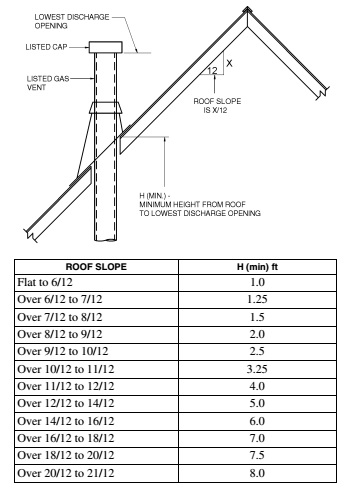
Salting and rusting elbows on a new-in-august furnace is not normal. No one here can tell you what the problem is without knowing a whole lot more information. However, I'd start by looking at the possibility of short cycling. How long does the furnace run each time it runs? The B vent doesn't need to project above the peak of the roof unless it's less than 8' from a vertical wall - then it need to run above that wall. If it's just on a sloped roof, the distance it has to extend depends on the slope. Here's a chart:

-
Ha! Oddly busy, in fact, given the market.
-
Sorry to chime in so late. As the other guys have said, the prohibition appeared in the 1993 NEC. Of course, VA might have been slow to adopt that version, so it could have rolled in a few years later.
-
I think you're addressing the symptom, not the problem. Contrary to your statement, modern washing machines discharge less (far, far less) water than older washers. If the new LG washer is causing the drain to overflow, its either because the drain is corroding on the inside and needs to be replaced, or because the person using the washer is putting too much detergent into it. Modern HE washers need a tablespoon or so of detergent. If you use the same amount that you used to use in an old top loader, you'll produce waaaay too many suds, which will choke up the drainpipe. Really, I can't stress this enough, use just a little bitty bit of detergent with any modern HE machine. As for your proposed solution. I have no idea what you're talking about. You say that you already put a larger pipe in, but that the wall won't let you put a larger pipe in, but you're going to put a larger pipe in. ??? How old is your house. What kind of pipe serves the washer?
-
Newly Changed Shims Good or Bad?
Jim Katen replied to EmperorSunLao's topic in Foundation Systems Forum
I agree that a 2" solid concrete pad should have been installed there. But that plan was screwed when the house was built - there's no room for a 2" pad now. Trying to add one isn't going to be worth the trouble and, in my experience, will just make a mess of things. You'll end up two steps behind where you are now. Personally, I'd cut my losses and call it good. -
I've used both, but I find that the phone is far less versatile. Aside from the poor macro capability and poor dark-attic performance, it's a terrible form factor for a camera; it forces me to use two hands to take a picture. With my regular camera, I take 95% of the shots one-handed. That just doesn't work with a phone.
-
After some research, it looks like a Z wave receptacle. Either one or both sides can be controlled by a Z wave hub. As I understand it, this is a wireless version of the old X10 system.
-
I can't speak to boilers. For water heaters, it's not that the water heater uses more hot water, it's the people that do, at least in the US. (I'm not sure about Canada). When you tell US of Americans that they'll never run out of hot water, they don't use a little bit more, they use a whopping bit more. Every time it's been studied, it's been the same. Not true in Europe, interestingly. Europeans tend to use the same amount of water with tank type or tankless hot water sources.
-
That's a new one to me. I couldn't have resisted pulling the faceplate and exploring that one.
-
In the picture, I slid the slate up and lifted it out. I was unable to dislodge the hooks when I pulled on them with moderate force. They're not about to let go under the weight of a slate - walking on them, though, that could be a problem. As for the underlay being the real water barrier, that's exactly how shakes work. The plastic under these slates was substantially tougher than the 30# underlayment that we put under shakes. There were no gaps, the slates were butted tight to each other. I can see this system performing well for 30-50 years, depending on the quality of the slates, themselves.
-
So I'm guessing it hasn't been around long enough for it to show any signs of serious failures yet. . .
-
Any idea how old this system is? The house I saw it on was built in 1992 and there was no sign of a previous roof covering.
-
I have only passing familiarity with slate roofs, but I've never seen a slate roof system like this. There's plastic interlayment between every course and each slate is held in place by hooks. The overlap between slates is only 1/2" to 1-1/2". Clearly this is some kind of proprietary system, but I'm not familiar with it. Does anyone recognize it?
-
My version of the code reads 60" above any standing or walking surface, which would include the tub deck. (IRC 308.4.5)
.JPG.a641188add629a72e57e44412caa909c.JPG)
.JPG.18573e65619906c6ea07ead11e1171c1.JPG)
.JPG.759fae2ea686cd2deb28f7c0036466ad.JPG)