Jim Katen
-
Posts
10,287 -
Joined
-
Last visited
Content Type
Profiles
Forums
Articles
News for Home Inspectors
Blogs
Gallery
Store
Downloads
Everything posted by Jim Katen
-
It seems oddly symmetrical. Were the separate entrances for men & women?
-

-
I don't know if it's the same company but it's likely.
-
Shaw fireclay kitchen sinks are very popular around here, especially the farmhouse style. I've always liked their products, which seemed to be of high quality. Lately, though, I'm seeing one after another with extensive chipping and crazing of the finish. On some of the crazed ones, stains have worked their way under the glaze and look like bruises. Last week, I saw one sink with over 70 small chips in the bottom and another with over a dozen. Is anyone else seeing this? Has Shaw, perhaps, had a run of bad sinks?
-
Possibly the worst home inspection website I've ever seen. Nothing about it makes me want to hire you.
-
Given the uselessness of testing, absolute answers to your questions are unknowable. That said, if we're talking about assumptions, I think it's safer (for everyone) to assume that Zonolite does contain asbestos. Likewise, it's *unlikely* that an attic can be insulated with Zonolite and not be contaminated.
-
There are stickers on them somewhere. It was a requirement and they had to be visible after the baseboard heaters were installed - although they might have been painted over. In general, you'd replace the old heaters with new heaters of the same wattage. If you can't find stickers to tell you the wattage, an electrician can tell you what they are by measuring their amp draw at the service panel. In 1969, they're going to be 240-volts so you should replace them with new 240-volt units. I don't know why you want to replace the heaters, but if it has to do with efficiency, don't bother. New baseboard heater's aren't even a tiny bit more efficient than 1969 baseboard heaters. They're both 100% efficient - 100% of the electricity that they use is turned to heat.
-
How old is the house? What is the wattage and voltage of the existing baseboard heaters? (This will be printed on a little sticker inside the heater at either the far left or far right side. You should be able to see it by putting your head down near the floor.) Why do you want to replace the existing heaters?
-
Make the next one a Rheem Marathon. At least it'll never rust.
-
For a while Ruud used Monel tanks. They'll last forever. I figure that I'll keep my water heater running until we develop the technology to "beam" it out.
-
I've seen a few that were in the 50+year-old range. The only thing that prevents most water heaters from lasting that long is deterioration of their tanks. I'm determined to make my own 1993 American water heater last for 50+ years by regularly changing the anode. In fact, I *need* to make it last that long because I mis-under-estimated when I was building the house and the water heater closet's doorway is 2" narrower than the water heater. . .
-
I can't recall having ever seen one. It looks like both elements fire at once - a poor design that will heat the water slowly.
-
Taping the joints was never recommended or required. In fact, with listed B-vents it's prohibited - always has been. If we're talking about a Category I furnace (hot exhaust) there should be negative pressure in the vent anyway - never positive pressure. That's part of the definition of a Category I furnace. The furnace motor does not "push" the exhaust through. The exhaust rises by buoyancy, creating negative pressure behind it. The draft inducer (the thing you're calling the furnace motor) only serves to draw a regulated amount of air across the burners - it does not "push" air through the vent. Category IV furnaces are different. They require sealed pipes - but not with tape. Their pipes must be cemented plastic.
-
Help identify this insect debris
Jim Katen replied to Inco's topic in Pest Control (WDI, WDO and Rodents)
Looks like general dust & debris sifting out from the gap between the window frame and the window casing. Seriously? It's just as easy to omit flashing on an Anderson window as it is on any other window. -
Is this an unfinished basement then? In my area, a builder would never leave framing exposed like that - the home inspector could see way too much.
-
Help identify this insect debris
Jim Katen replied to Inco's topic in Pest Control (WDI, WDO and Rodents)
That's spider debris. The small separation at the top of the window shouldn't be related to insects. Is the window flashed on the outside? -
A header is a beam, so 502.8.1 for all the limitations. If this is a pre-drywall inspection, why not just look at the plans? I doubt that they specify that particular detail.
-
That siding is much younger than 35 years. The house has been resided.
-
Yellow Liquid in Bath Fan Vent
Jim Katen replied to CNewhouse's topic in Architectural Nightmares and Remuddles
In our area, 90% of the bath exhaust ducts stop a foot or so away from the vent jacks. No need to disconnect them because no one ever connected them in the first place. -
Looks like a hardboard face pressed onto an OSB back. I don't recognize that particular product, but Masonite used to make one with similar construction.
-
Landings versus steps for extending front porch
Jim Katen replied to JAG70's topic in Exteriors Forum
If the front yard was excavated to install dimple board, then you really don't want to put a bunch of concrete on it. The new concrete will sink into the back-filled yard like a fat man sitting on a cheap couch. Don't do it. A 6x10 porch is plenty big enough for Mama to sit out there with a mint julep and get into the neighbors' bidness. Making it much larger and she'd have to sit out in the sun. -
Sorry, I don't speak bullshit. Could you explain *exactly* what it is that you plan to do?
-
Landings versus steps for extending front porch
Jim Katen replied to JAG70's topic in Exteriors Forum
I think the porch is fine the way it is. Invest in some good landscaping for crying out loud. It'll do way more for the house than a bunch of pointless concrete. -
SEC Neutral wire spliced with multiple wires
Jim Katen replied to Mike Lamb's topic in Electrical Forum
It's pretty damn wrong. I'd certainly tell them to get it fixed.- 1 reply
-
- 1
-

-
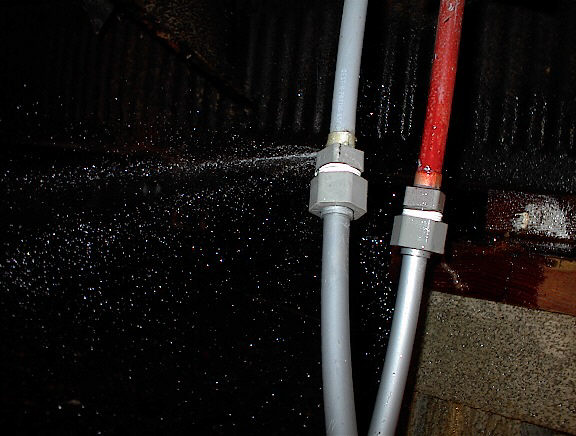
What Marc said. It could easily be a leaking joint. When they replaced the water heater, they probably didn't even look at the furnace. On another note, your garage floor is supposed to slope to drain to the driveway. If it really had an inch of water in it, something's wrong there as well.
.JPG.47840914785a9e0de7ebc0e3f5a0e6c9.JPG)
.JPG.900bac13ead061d4e63712f3c93d9832.JPG)
.JPG.13c5d64ff7b19a153bbe01c5ebea20fd.JPG)