Jerry Simon
-
Posts
1,562 -
Joined
-
Last visited
Content Type
Profiles
Forums
Articles
News for Home Inspectors
Blogs
Gallery
Store
Downloads
Everything posted by Jerry Simon
-
Could be. I'm gonna switch the one original bulb that's lasted several months to the suspect fixture. This bulb is from the same batch as the ones that burned-out, but it's lasted quite a while. I'll also tweak the contact at the bottom of the socket per Mr. Katen's suggestion. Perhaps these actions will enlighten matters.
-
Here we are, ten days later after switching the two fixtures as James suggested. Same fixture, now on the left side instead of the right, just burned out a bulb. (Again, I already replaced this almost brand new fixture with an even newer one, suspecting it was the fixture itself.) This is odd.
-
The long-lasting bulb is first in the circuit. *Evil* fixture is second in the circuit. I just switched fixtures. If bulb in (now-switched) second fixture in the circuit burns out again, I'll pull new wire from the first fixture to the second fixture (unless someone's got a better idea). Fixtures are brand new. *Bad* fixture is twice brand-new.
-
No. Yes, it's first or second. When I switch them, as James suggested, I'll see which is first and which is second. What's your thought here?
-
Yes. Yes. No.
-
Will do.
-
I replaced the two pendant lights above my kitchen island. One of the fixtures kept burning-out bulbs after about a week. Happened four times in a row, so obviously something amiss (but again, the bulbs lasted about a week each, using fixtures a few times a day). Thought maybe a bad bunch of bulbs. Happened with new bulbs. All the while, the adjacent new fixture was fine & dandy. Okay, loose neutral. Nope. Tightened up everything at both fixtures. Same result; new bulbs last about a week. Okay, bad fixture. Nope. Returned and exchanged, and no good; burned out the bulb in about a week. Okay, voltage amiss. Nope; 123 volts, just like its new neighboring fixture. Could voltage somehow fluctuate at just the one fixture? Any help would be appreciated. (And, no, this isn't the caulk issue I asked about earlier; aside from a burnt-plastic odor every time I use that fixture, it worked great. Kidding. . .)
-
My house is wired with modern thermoplastic-covered wiring in EMT (pipe). Ceiling is roughed-in for ceiling fan. When I went to install a ceiling fan, one of the six wires coming out of the pipe arced on the sharp edge of the end of the pipe; blew the breaker. There is no extra wire here, and I can't get the damaged part of the wiring insulation out of the pipe to tape. Scissor truss above ceiling junction box, and can't (easily) access. I'm thinking of filing about the last 1" of the end of the pipe with clear silicone caulk; that will coat any areas of damaged wiring insulation. Once dry, I'm thinking this might be adequate. 'Course, I've never thought about whether or not dried silicone caulk would be a good insulator. Thoughts?
-
Attic Mold Boiler Plate
Jerry Simon replied to Mike Lamb's topic in Report Writing and the Written Word
Am always looking at ways to write a better report. Have not giving it much thought as to why I leave out "I" and simply start with Recommend. Guess it's because people know what I am talking about. Look report writing as more of a technical writing format that's not the same as typical grammar. Try not to overuse use the term "further evaluate". However, feel it's the best term to use in many cases. Am open to new ideas if someone's got a good replacement for "further evaluate". I took the liberty of revising your paragraph; it's in italics above, leaving out the first word of each sentence (the "I"). IMHO, it does not sound technical. That said, I used to be guilty of same when I first started. Not sure why; maybe I just wanted to sound important. -
That show pony is also long-dead here. . .
-
Expansion/movement joints at brick veneer walls
Jerry Simon replied to Mike Lamb's topic in Exteriors Forum
Wall heights? -
Never did find out. They replied to my specific inquiry about such with more puffery, and zero details on the warranty. I replied back asking if they even read my email. . . Didn't hear back about that either. This spoke volumes to me. Ain't gonna go any further. That said: I just though it would be a good tool to try and snag a price-shopper; would never offer to a *normal* client.
-
OREP offers a 90-day home inspection warranty for your/our clients. It sounds like a good tool when trying to book price-shoppers. And, it's fairly cheap ($12.50 -$14.00). I don't know the warranty *fine print* yet, though, and am waiting to hear back from OREP about such before I decide if I want to use it. Does anyone have any experience/thoughts about this?
-
I would think the wall framing would also have to be robust to support such a roof?
-
It is a split bus panel. A split bus panel does not have a main disconnect. The service capacity is determined by the service entrance cable size and/or the rating of the main panelboard, not the 70-amp breaker.
-
Actually, he was being more than nice.
-
The thin keyway areas (or "slots" as I call them) are also very susceptible to hail-impact damage. A hailstorm can destroy a wood shake roof overnight due to such slot damage. It's probably the biggest problem I find with wood shakes in this neck of the woods.
-
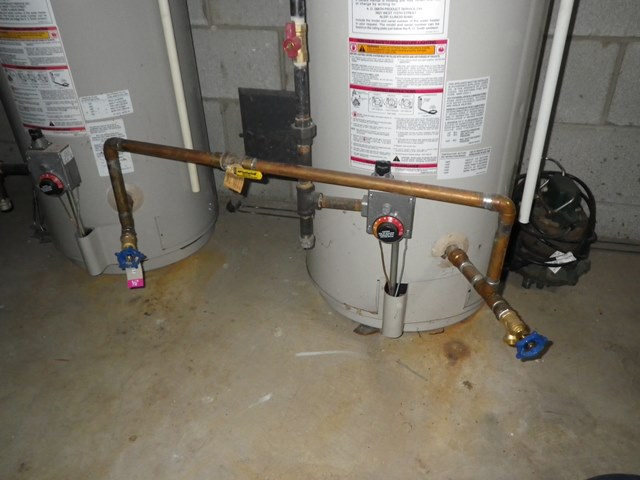
Not that it makes a difference (or does it?), but I erred when I said in-series. The heaters are piped in-parallel.
-
Series
-
Why would one tie the two bleed valves together, with a ball-valve in the middle of the pipe? (No signs of a *looped* system.)

-
And as Sir James alluded to, the groove is the *reglet*.
-
What is the rationale for not allowing lower branch circuit wiring to run back through the main service entrance cable raceway (what are the risks)?
-
I agree; they'll warp/twist. That's why I prefer a wood beam in most cases versus a steel beam.
-
What is your concern, other than the apparent rareness of such? After 45 years or so, are they failing?
-
Good recommendation. It also appears in your third photo that the ductwork is Transite, and same in very poor condition as well.