Jim Katen
-
Posts
10,287 -
Joined
-
Last visited
Content Type
Profiles
Forums
Articles
News for Home Inspectors
Blogs
Gallery
Store
Downloads
Everything posted by Jim Katen
-
Welcome to the world of wooden floor framing. If you're accustomed to concrete or masonry construction, wood-framed construction can often seem flimsy, but it's surprisingly resilient. Floors that flex a bit underfoot are *very* common. Many years ago, there was a TV commercial for a special kind of floor framing in which a china cabinet rattled when a little chihuahua walked by. Most viewers understood the reference because bouncy floors are so common. Flex in floor framing has nothing whatsoever to do with the floor's strength. If an engineer looked at your floor and said that it's fine, it almost certainly is fine. If the bounce bothers you, any carpenter can add supports to eliminate it. Just don't confuse deflection with strength.
-
Pictures?
-
Or thirds.
-
Sure. Just install one of those under-sink recirculating pumps. It pumps water from the hot pipe into the cold pipe until its thermostat tells it that the water is hot. You can even connect them to a motion sensor so that they only work when they sense motion in the bathroom.
-
6-year old roof. I don't recognize this brand or model of shingle. Lots of the upper lamination tabs were twisted. While it looks goofy, I doubt that it'll have any effect on the roof's performance. Has anyone else seen this? Any idea what caused it? Is this some new look that the kids like these days?

-
SEC wire capacity just short of main circuit breaker size.
Jim Katen replied to Mike Lamb's topic in Electrical Forum
Depends on the edition of the NEC. That table was removed in the 2014 & 2017 NEC editions and replaced with the 83% rule. Then the 2020 edition brought it back, but it's now Table 310.12 and it carries the caveat that it can only be used when there are no adjustment or correction factors required. It's exactly the same as the document that I attached. -
SEC wire capacity just short of main circuit breaker size.
Jim Katen replied to Mike Lamb's topic in Electrical Forum
Or just use this handy pocket table: AWG table.pdf -
SEC wire capacity just short of main circuit breaker size.
Jim Katen replied to Mike Lamb's topic in Electrical Forum
If this is a service entrance conductor that's carrying the entire load of the service and if there are no derating issues at play, then you only need to size the wire at 83% of the load. In effect, a 100-amp service only needs to have 83-amp service entrance wires. That makes #2 AL THW a perfectly valid choice. -
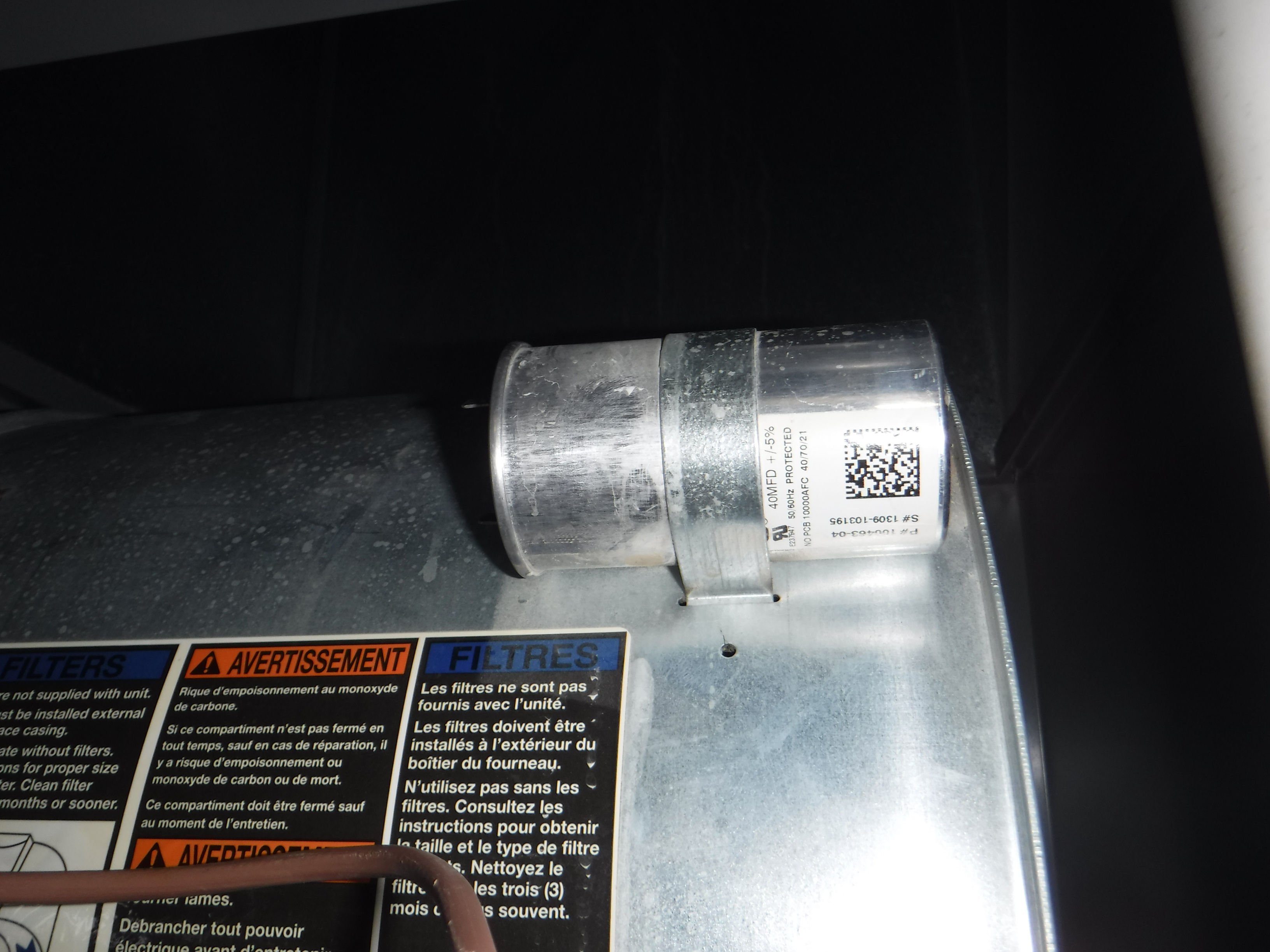
Perhaps. Or maybe the manufacturer was putting together a furnace with an ECM motor and they just slapped on the wrong shroud one day - or maybe the cap had already been installed on a shroud and someone forgot to take it off.
-
Really? I've seen many - or perhaps the capacitors were hidden.
-
Sorry. I just added the picture.
-
Found in the attic of a 1922 house. I've seen lots of old bundles of shingles in the corners of basements, garages, & crawlspaces, but I've never seen asphalt shingles packed in cedar crates. Even the oldest were wrapped in Kraft paper or something similar. Maybe I've just led a sheltered life.
-
One of my partners snapped this picture of an unconnected capacitor in a 2013 furnace. My best guess is that the manufacturer uses one shroud for both its cap blowers and its non-cap blowers. Any other insights?
-
Listing Agent Requests Insurance Claim
Jim Katen replied to CNewhouse's topic in Insurance Questions
I doubt that you'll ever hear from her or about her again. That kind of behavior doesn't tend to result in a successful career in the world of real estate. -
Listing Agent Requests Insurance Claim
Jim Katen replied to CNewhouse's topic in Insurance Questions
I'd explain it to the listing agent exactly as you did to us. I'd decline to pay for it and go about my business. If they're serious, they'll follow up but in my experience, they never do. -
Mold on light fixture?
Jim Katen replied to JCL's topic in Indoor Air Quality (I.A.Q.) and Mold Forum
That's corrosion. -
A whole new circuit is a great way to go, especially if you're not paying someone else to do it.
-
Depends on your local codes. If the building is only two stories, it might not be a problem. Call the local AHJ to find out for sure.
-
Does a firewall prevent mold from spreading
Jim Katen replied to daytonafuture's topic in Attics & Insulation
Wait for him to build up enough useless comments, then he'll insert a link in his signature. . . -
I think you mean 6 awg and 8 awg. (Or #6 and #8 for old-school types.) 6/0 would be huge. Yes, it'd be fine to extend the #6 aluminum circuit with #8 copper, just be sure to use the proper connectors. I'd use split bolts, which are listed for aluminum and copper in combination. Be sure to properly insulate them - doing this properly requires three different kinds of tape and a little skill. Here's a great video:
-
Thanks. I appreciate the followup. I'll bet that your post will help a lot of people who want to attempt a re-string but lack confidence.
-
space between under my deck and my house.
Jim Katen replied to JKW's topic in Landscaping & Site Drainage Forum
How about bentonite cat litter? When dry, it'll flow like sand all the way to the bottom of the void. Once it gets wet, it'll swell up and serve as a decent water barrier. -
Article: Key Elements for Pre-Inspection Agreements
Jim Katen replied to Nicole Barns's topic in Insurance Questions
What a useless and badly written article. -
I left comments with the pictures. One picture shows some severely deteriorated mortar. Otherwise, it all looks very typical. What you've got there will probably support the house just fine as long as gravity is the only force acting on it. This house was build just after the big 1906 earthquake and it looks like it rode out the 1989 Loma Prieta quake without any serious damage. It might not do as well when the next large one hits. If that were my house, I'd get some modern earthquake retrofit work done.
-
It's a bit low, but it should be fine as long as the water service pipe is large enough to allow adequate flow. My house has about 37 psi on a really good day (when the water level in the reservoir is at its highest level). In the summer, when several of my neighbors are irrigating and the reservoir level drops, my house only gets about 24 psi. It can be a problem for us because the line between our meter and our house is only 3/4" PVC and it's about 800' long with a rise of about 100'. That said, I can still get a decent shower even when the pressure is at its lowest. We raised three kids under these conditions and it was generally fine. That said, I'm still surprised by the force of "normal" showers when I stay in a hotel.

.JPG.577ddaef88edae057a6904d68dc7a559.JPG)
.JPG.376437ba9ffd581456f62537f6d6048f.JPG)
.JPG.713150e4b48fc640bbb3e5ddf7cfee17.JPG)