


Jim Katen
-
Posts
10,287 -
Joined
-
Last visited
Content Type
Profiles
Forums
Articles
News for Home Inspectors
Blogs
Gallery
Store
Downloads
Everything posted by Jim Katen
-
Oy. Now you're dating yourself.
-
Oh, heck, this thing wasn't even mentioned in the report. It wasn't even near the house. I was just curious.
-
According to whom?
-
It's just possible that I've never heard that term before. Thanks.
-
I've always understood a gazebo to be a place of shelter (necessitating a roof) where one could "gaze" at the scenery. This provides neither shelter no view and is, in fact, more like something to be gazed upon, which has no other practical use - hence my leaning toward a folly.
-
Is there another name for this structure, other than a folly?

-
to hire an architect
Jim Katen replied to Chris Jackson's topic in Architectural Nightmares and Remuddles
Not in the Philippines. -
Some jobs are more interesting then others
Jim Katen replied to Mark P's topic in Environmental Hazards
What were you hired to do? If I were interested in developing that building into usable apartments, I'd start with a Capital Needs Assessment. -
Well, never say never. I just ran into this today. 1954 house - note the postal zone in the address. It was a nicely made panel.
-
I think you'd have to look at the packaging or catalog to know for sure. FWIW, I wouldn't consider that to be a wet location.
-
I'd think that beadboard wainscot would be a better choice than either one.
-
I'll bet you a dollar that it'll be impossible to remove that lug cleanly.
-
Installing Z bar flashing under existing hardie help?
Jim Katen replied to Anna's topic in Exteriors Forum
To do this properly, the building paper under the siding has to overlap the z flashing. That's not possible to do by sliding it in from the side. Just remove the course of siding above each place you want to flash, install the flashing properly, and then replace the siding, typically using a pin gun. If you could remove the original piece without damaging it, great. If not, replace it with a new piece of siding. These kinds of repairs are done every day - it really shouldn't be too much of a trial for a contractor. -
What is it that you're hoping to achieve with the plywood? That will help with the recommendation.
-
Something is wrong with that explanation. Smart meters don't need to tap the main lugs in a service panel. They're already attached to the SECs inside the meter base. There's nothing more that the meter can learn from tapping the main lugs. Especially not with copper wires mixed with aluminum wires in lugs not listed for that. I'd tell the utility to keep their grubby wires out of my panel. Those are some interesting parallel SECs. What kind of building is this?
-
No, this is a different panel. The one you posted before had all different breakers. Like Marc said, the big bare copper wire is the incoming neutral. What's missing is a grounding electrode conductor.
-
I don't recall ever hearing of them.
-
I generally agree with you & Chad, but here's my thought process: Zip codes started in 1963, and postal zones (one or two digit codes) go back to 1943. This one has neither, but it certainly doesn't pre-date 1943, so the absence of a code doesn't necessarily date it. (I've found the presence of a zip code or postal zone to be good at dating a furnace, but the absence of one doesn't mean much. It could be that they didn't feel the need to add a zip code (or postal zone) since they weren't mailing it. . . ) I agree about the chrome and the likelihood of it being from the '50s, but the sticking point is that this was a gas furnace from the get-go - it wasn't converted from oil, and there's only a small chance that this house had gas service in the '50s. Portland didn't have any natural gas until 1956, and even then, it was quite rare until the '60s. (We had manufactured gas much earlier, but that was long gone by the '50s.) So the '50s is possible, but unlikely. The data plate states 66% efficiency (90/135), which is probably what it gets when everything is perfectly balanced, it gets a rolling start, and it has a tailwind behind it. One of my partners used to do combustion analysis on these things and he said that, once tuned up properly (which wasn't particularly difficult), they could deliver about 65% efficiency pretty reliably. I was able to get a good view of the burner and the outside of the drum-style heat exchanger, both of which looked great. In the report I observed that the furnace is old and inefficient, but paid for and that it would probably outlast several If anyone's interested, I included this paragraph in the report:
-
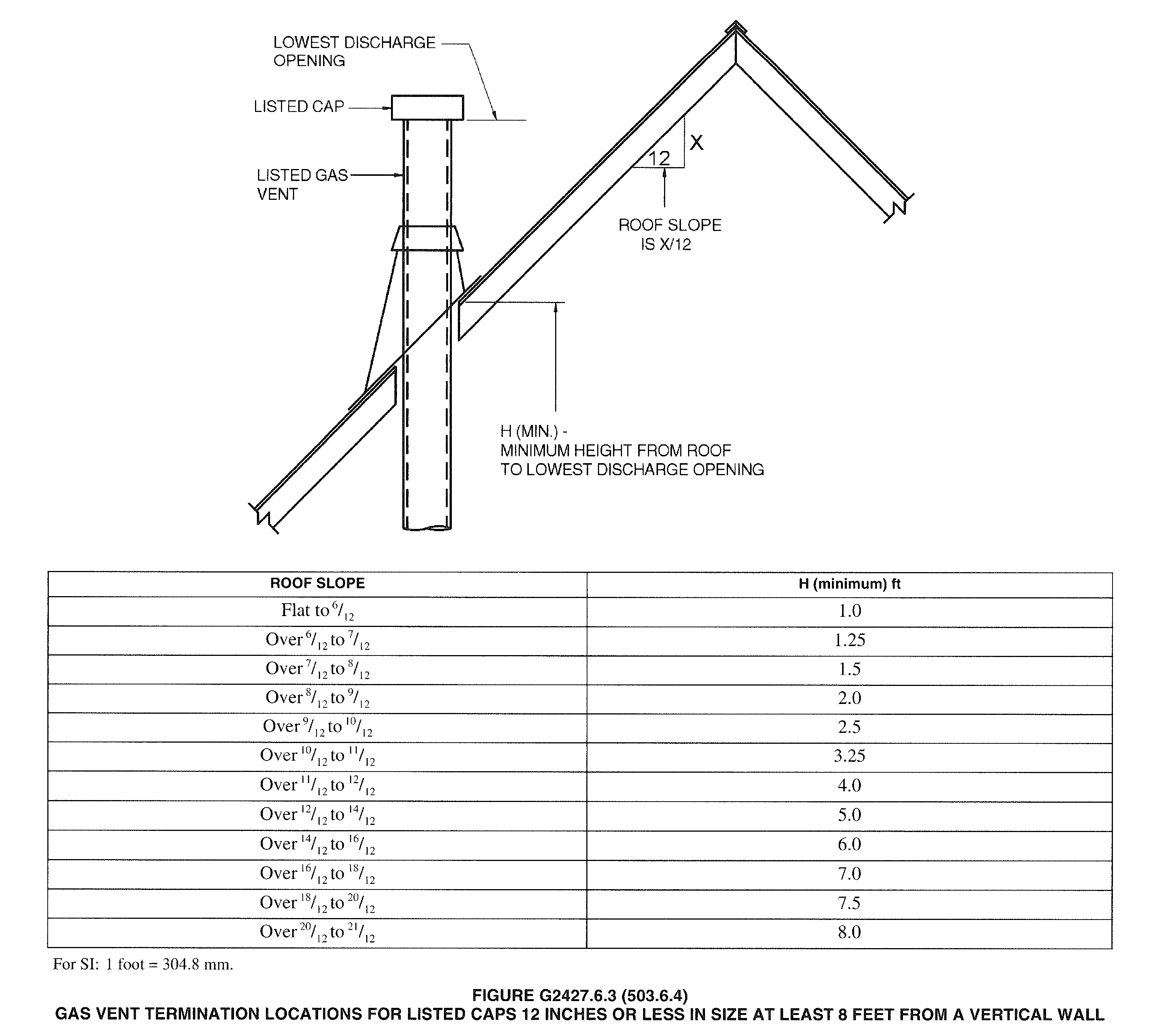
If only it were so simple. The rule you're quoting is for masonry chimneys that serve fireplaces. Alas, gas B-vents don't follow the rules for "chimneys." Their minimum height above the roof depends on the slope of the roof and the diameter of the vent. Maybe, or maybe not. There's quite a bit of leeway when you actually do the calculations.
-
I think it would be nice to have a rule to refer to, but I'm also unable to find one. Without a rule or other reference, the HVAC contractor isn't going to know what to do. After all, he or someone like him installed it in the first place. For things like this, in the past, I've asked the furnace manufacturer for a written opinion, and used that.
-
What do you Michiganders think? 1960's?
-
This is all spot on, but Mike forgot to mention one of the most common problems that causes excessive build-up of this salt: short cycling. If the furnace is over sized, if the thermostat is poorly located near a supply register, if the burners are over-firing, if the high-temperature limit switch is failing, the furnace might be shutting down before the flue comes up to a steady-state temperature, allowing lots of condensation to build up in there.
-
Without pictures of the stuff and the entire configuration of the installation, my best advice is to sweep up all the debris, throw it out, and go have a beer.
-
You might want to revisit that policy. While it's certainly the easy path, it's often not the right one. Classified breakers meant for that panel are perfectly acceptable, no matter what the manufacturer attempts to claim.
-
It's disturbing that Square D would lump counterfeit breakers in with classified breakers, which are specifically UL listed to fit into their panels. The thing that's particularly galling is that Square D makes classified breakers to fit into nearly every other panelboard out there, but they "prohibit" using other company's classified breakers in their panels. It's a racket and it's probably not enforceable under the Magnuson Moss Warranty Act, which specifically prohibits a company from requiring only branded parts be used with the product in order to retain the warranty. In fact, I seem to recall hearing that Square D took that bulletin off their website like 20 years ago. Did you find it on Schneider's website or has it just been re-posted on other websites since the early 2000s?
.JPG.7d6d23eadb4a9041333d8e3c9b91c471.JPG)
.JPG.6742c4c8e9de154d05116e764cc9cd0a.JPG)
.JPG.6aa9e1468130f2c95f919b8be13c9ab5.JPG)

.JPG.3556576a0a77fc73059eccf104a4a1bb.JPG)
.JPG.ac0dc59b6efeb333acc0869c33fcd7ed.JPG)
.JPG.8f456c9b65501db2484e3978cc429e89.JPG)