Marc
-
Posts
6,736 -
Joined
-
Last visited
Content Type
Profiles
Forums
Articles
News for Home Inspectors
Blogs
Gallery
Store
Downloads
Everything posted by Marc
-
I've a house with just 35 psi available at the first hose bib. Is this an issue?
-

Thanks in advance!
Marc replied to paul ferrari's topic in Professional Home Inspection Associations
I can't think of a better launchpad for a career in home inspection. But since your experience is limited to commercial, I offer a few words of what you might encounter as an HI. This is a profession where you will frequently encounter agents. Agents have a professional duty to serve their buyers, but by law, they receive compensation only via a commission, and only if the house is sold. Inspections, by their very nature, don't help the agent sell the house and secure his commission. It's the opposite. The better an inspector can serve a buyer, the more of a threat that inspector is to the agent's commission. That means agents are conflicted with knowing which inspectors can best serve the interests of the buyer, on account of the agent's personal interest in their commission. Buyer's are seldom familiar with this conflict of interest, and there is no reliable metric on inspector performance that buyers can use to vet their inspector. The result is that many buyers accept an agent's recommendation on choice of inspector. In my area, at least 90% seem to. One effect of it is that our profession's practitioners tend to be the ones who produce the reports that agents like, the ones that aren't a threat to their commission. In this way, our entire profession is contorted and subverted. As an entry level inspector, if you want to be successful you must make yourself more appealing to agents than your competition. You must do what your competition does, only better, even though the buyer gets screwed while paying for everything, the house, the agent and the inspector. This effects of this conflicts aren't as bad everywhere in the country. Some places, like mine, it's worse, other places it may not be significant. -
I'm not aware of any shingle manufacturer that prohibit open valleys but there's things far more seriously wrong with the roof on that photo than the fact that it has an open valley. The valley is lined with laminated shingles, shingles that are not intended for such low slopes, nor even for curved surfaces. Even without an establishing shot, I'd say that roof has a serious framing error. The central area within that photo would have been better framed with a flat roof and a single membrane roofing material, such as Mod-bit, EPDM or TPO. Until it's corrected, that area of the roof will always be a problem. Problems that are built into a house are among the most difficult and expensive to correct.
-
I'd absolutely replace the entire system upon failure of the compressor. The reason is very simple: R 22 is now phased out. Prices for this refrigerant is now more than 10 times higher than it was before the phase-out began.
-
I don't see any need to change the size of the pulley, provided that the RPMs of old and new motors are the same. The smaller pulley for the higher horsepower is likely to take advantage of the extra horsepower by increasing the blower speed. I wouldn't go there. Make sure the 'frame size' and shaft diameter are the same for the new motor.
-
That sort of construction is fine if the house isn't wood-framed. Otherwise I tend to look for the consequences of it before I write it.
-
I've got this slab supported, one story house with a storage room converted to laundry/bath. The guy didn't want to break any concrete to lay down drain lines, so he built up a portion, but not all, of the floor with wood framing and ran the pipes in there. My concern is trip hazards. The discrepancy in floor heights is now up to one foot. Where in the IRC do I find cites that comment on this? Thanks in advance.

-
chimney cap drainage
Marc replied to Jim Baird's topic in Fireplaces, Chimneys & Wood Burning Appliances
It does keep water from getting where it doesn't belong. Doesn't make it into my report. -
Limit switch, blower motor or the condenser on the blower motor - if it has one.
-
That's pretty much what I was saying. Same with roofing. I don't like adding layer after layer.
-
I've never been a fan of building over trash. I'd tear it off.
-
I suspect that, by 'upgrade', Trent meant a new computer. If you want to be able to upgrade the latest operating system on the same computer, get a Mac.
-
The T&P drain line should never rise or even level off. It needs to slope downward in the direction of drainage throughout it's length for precisely the reason the inspector mentioned.
-
Mold in AC Unit
Marc replied to richardbreiter's topic in Indoor Air Quality (I.A.Q.) and Mold Forum
I think one of the causes is that the closet doesn't have adequate ventilation. Moisture level soar when there's no ventilation. -
If the gables are vented, you don't need soffit vents.
-
If an electric element is bad, you'll likely see where it's broken, just by looking at it closely, tracing the elements throughout their length. These heaters won't blow hot air, just warm air. Electric doesn't get as hot as gas-fueled furnaces. If you want to know if it works, turn it on and check the amperage. It'll draw about 16 amps for each element that's connected. For example, if three elements are connected, it'll draw about 50 amps, more or less. Still won't give hot air, just warm. Sometimes, not all elements are connected. Check to make sure they're all connected but don't connect any that are not already connected, let an AC guy do it to make sure you've enough wire to handle all elements. If you need parts, try asking Google. That's what my AC wholesaler does.
-
Which is better HIP Pro or Palm Tech
Marc replied to platshaw's topic in Report Writing and the Written Word
The vast majority of the time that I spend on report writing is not spent finagling the format, or even the photos, it's coming up with the complete sentences that express precisely what I've seen, as simply, briefly and coherently as I can. None of that 'Inspected, Inspected, Inspected' drone that plagues so many reports. That's the true labor of report writing. No software can do that. Efficiency doesn't even enter the equation. -
Mold in AC Unit
Marc replied to richardbreiter's topic in Indoor Air Quality (I.A.Q.) and Mold Forum
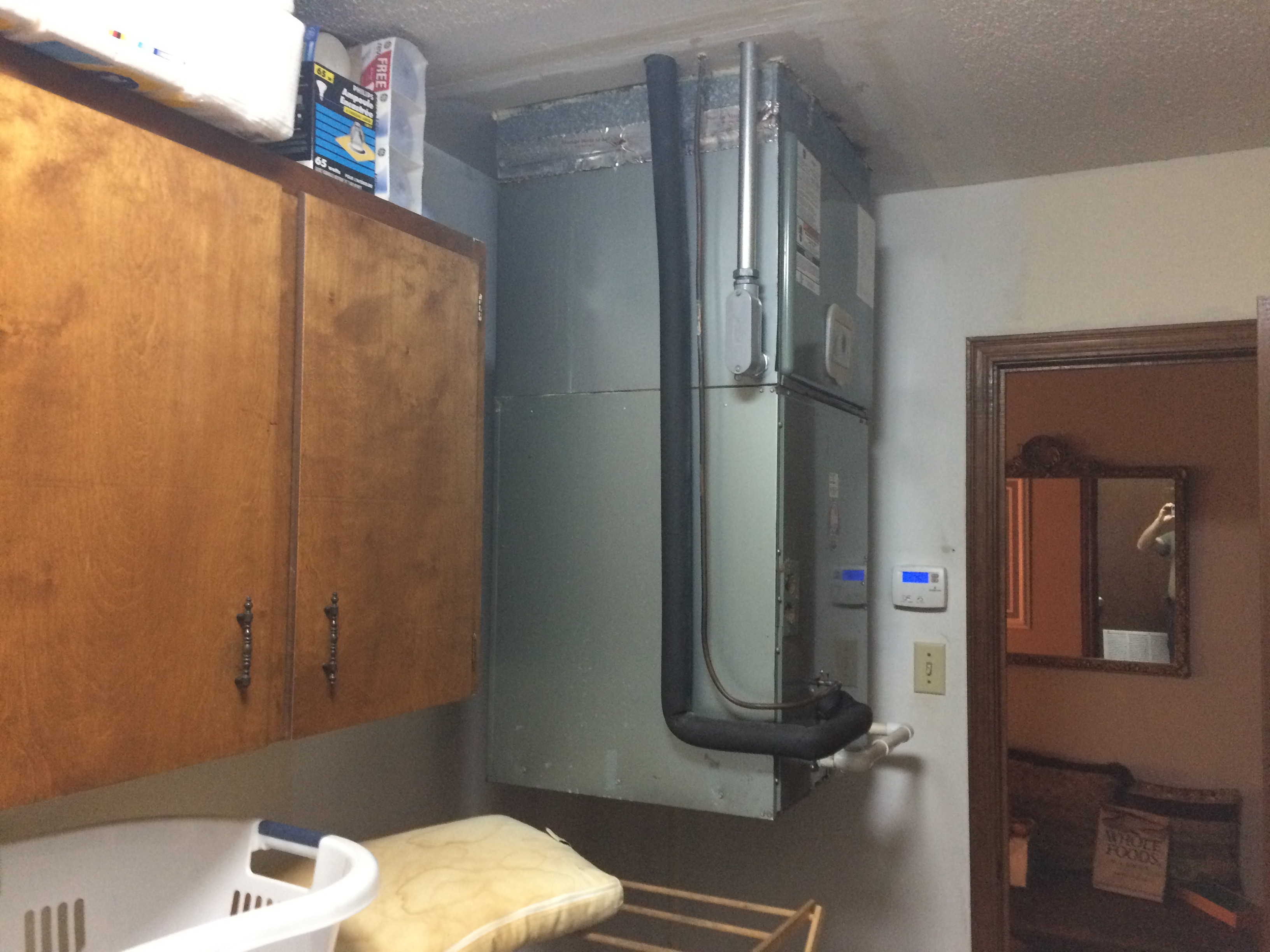
An AC indoor section is a place where cold surfaces cause moisture to condense and form water. Mold spores are microscopic and everywhere so all that it takes for it to grow anywhere is sufficient moisture. Your AC closet likely has mold on it's walls because a high moisture source is there and there isn't enough ventilation when the AC isn't running to dry it out quickly enough. Before the new AC is installed in the closet, get in there and clean off the walls with paper towels and a bottle of Tilex. Try to alter your AC installation so that it has ventilation at all times, especially when it isn't running, so it can dry out promptly. You'll likely still get some mold growth but perhaps not as much. Clean it with Tilex once in a while. I'm an AC tech and my AC was once in a closet, so I took out two walls of the closet, suspended the AC by the plenum from the ceiling and now it's in the laundry room. The only mold growth related to it is on the primary drain pan of the cooling coil. I clean it once in a while. Takes less than a minute:
-
Does this look like mold?
Marc replied to ArVandelay24's topic in Indoor Air Quality (I.A.Q.) and Mold Forum
For the time being, I'd suggest reading Jim K's post more, writing less. It took me years to figure what the heck Kurt M was talking about, but when I did, my respect for him went sky high. Jim's in the same league as Kurt. He has a lot to teach but you have to listen closely and read between his lines to get his meaning. You'll see. He's actually a very gentle and kind man. One of the most composed and collected I've ever known. -
Which is better HIP Pro or Palm Tech
Marc replied to platshaw's topic in Report Writing and the Written Word
I'm not impressed with any of them. I use Word. -
Does this look like mold?
Marc replied to ArVandelay24's topic in Indoor Air Quality (I.A.Q.) and Mold Forum
Jim's ahead of you, like..so far ahead you can barely see him. Post here a couple thousand times more and perhaps you'll get it. -
Squirrels causing cracks and missing shingles on ridge vent?
Marc replied to Nancy Leopold's topic in Roof Forum
Doesn't look like wind damage. I've squirrels and coons in my backyard everyday but my house has no ridge vents. I haven't seen this before. -
Does this look like mold?
Marc replied to ArVandelay24's topic in Indoor Air Quality (I.A.Q.) and Mold Forum
I don't think so. Just dirty. Only a lab knows for sure. -
Geez. That's a lousy standard. I don't believe I would stay in this profession if I had to follow that.
-
The body of knowledge needed to perform a decent home inspection is very large. The NHIE is meant to test only for 'entry' requirements and there is study material designed to help you pass it but this study material, if taken alone, may leave you more handicapped as inspector. Anyone can pass the NHIE if you use the NHIE's study materials. Check the NHIE website. You'll find what I described. There is yet a school that teaches the NHIE's study materials. The current flock of HI schools is based on state regulatory requirements and is far inferior to what the NHIE provides. Once you've passed it, you can begin inspections and continue your education. That education, for progressive folks, does not end. The best inspectors are the ones who learn on their own. They are few and far between. I disagree with Jim. The lack of a background just means a longer road to proficiency as home inspector. The ability, and the drive, to learn something on your own is more important than background.