.jpg.20867d5d91c4a72e0d4afecbfa8c8e62.jpg)
Chad Fabry
-
Posts
4,431 -
Joined
-
Last visited
Content Type
Profiles
Forums
Articles
News for Home Inspectors
Blogs
Gallery
Store
Downloads
Everything posted by Chad Fabry
-
.thumb.jpg.47289739c2f0532f4faffd07858bee59.jpg)
When Someone Asks What Time It Is, Don’t Tell Them How to Build a Watch
Chad Fabry commented on Jim Morrison's article in Report Writing
Thanks, Jim. I've committed to following your advice. It's not easy to let go of bad habits. The reward will be clients who are better served through easier to read reports. -
No. I even pulled the cover to prove it to myself.
-
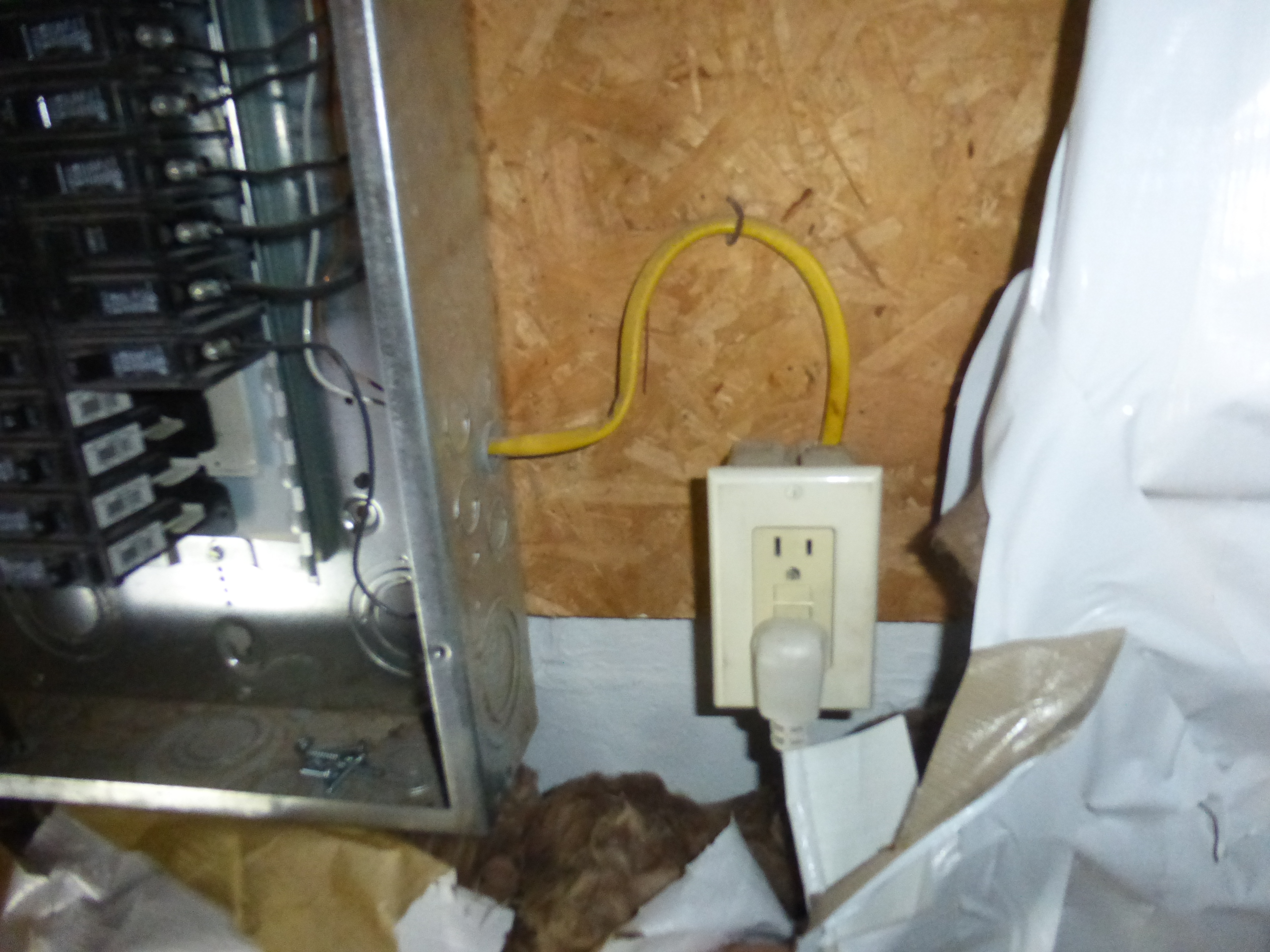
When I tested the GFCI located near the panel, the smoke alarm on the other side of the basement beeped. It beeped each time I pressed the reset button. The GFCI receptacle is the only outlet on the circuit. Anyone have any ideas why that would happen? The lowest breaker feeds the receptacle. ( Sorry about the crappy photo)

-
Induced current.
-
If that panel is the service equipment and the terminal is rated for two wires (it's probably not) then it's OK.
-
TPR drain interconnected with drain pan's drain
Chad Fabry replied to Trent Tarter's topic in Plumbing Forum
504.6 Requirements for discharge piping. The discharge piping serving a pressure relief valve, temperature relief valve or combination thereof shall: 1.Not be directly connected to the drainage system. 2.Discharge through an air gap located in the same room as the water heater. 3.Not be smaller than the diameter of the outlet of the valve served and shall discharge full size to the air gap. 4 Serve a single relief device and shall not connect to piping serving any other relief device or equipment. 5.Discharge to the floor, to the pan serving the water heater or storage tank, to a waste receptor or to the outdoors. 6.Discharge in a manner that does not cause personal injury or structural damage. 7.Discharge to a termination point that is readily observable by the building occupants. 8.Not be trapped. 9.Be installed so as to flow by gravity. 10.Terminate not more than 6 inches (152 mm) above and not less than two times the discharge pipe diameter above the floor or flood level rim of the waste receptor. 11.Not have a threaded connection at the end of such piping. 12.Not have valves or tee fittings. 13.Be constructed of those materials listed in Section 605.4 or materials tested, rated and approved for such use in accordance with ASME A112.4.1. 504.7 Required pan. Where a storage tank-type water heater or a hot water storage tank is installed in a location where water leakage from the tank will cause damage, the tank shall be installed in a galvanized steel pan having a material thickness of not less than 0.0236 inch (0.6010 mm) (No. 24 gage), or other pans approved for such use. 504.7.1 Pan size and drain. The pan shall be not less than 11/2 inches (38 mm) in depth and shall be of sufficient size and shape to receive all dripping or condensate from the tank or water heater. The pan shall be drained by an indirect waste pipe having a diameter of not less than 3/4 inch (19 mm). Piping for safety pan drains shall be of those materials listed in Table 605.4. 504.7.2 Pan drain termination. The pan drain shall extend full size and terminate over a suitably located indirect waste receptor or floor drain or extend to the exterior of the building and terminate not less than 6 inches (152 mm) and not more than 24 inches (610 mm) above the adjacent ground surface. Where a pan drain was not previously installed, a pan drain shall not be required for a replacement water heater installation. -
I'm fairly certain they spent more time on layout than I did.
-
"Alana, I figured out a way to save time mowing." "That's good, Chad."
-
Aluminum siding sucks heat from the house
Chad Fabry replied to Mike Lamb's topic in Exteriors Forum
The siding radiates only the heat that has already escaped the conditioned space of the structure. -
You can get answers, but it'll cost you. https://www.astm.org/BOOKSTORE/COMPS/GLASSCMP.htm
-
Townhouse= "A single-family dwelling unit constructed in a group of three or more attached units in which each unit extends from the foundation to roof with open space on at least two sides." Townhouses require a 2-hour separation. The photo does not depict a 2-hour assembly. Ironically, the same building, but used as apartments can get away with draftstopping (shown in the photo).
-
Is this some kind of bad ass spider?
-
Absolutely. I have your back.
-
The ladder in the link is different than the ladder that was in the link 3 years ago when I reviewed it. They used to be almost identical to LGs. That said, does anyone have a grandmother who lives near Jerry who may be able to help carry his ladders?
-
It doesn't look like spray foam, it looks more like the cementitious stuff they use on structural steel. That said, the party wall isn't necessarily required to be fire rated, it may be a smoke wall if the building has sprinklers and the attics have small enough areas.
-
Shot thru Windshield after a Mid March light snow
Chad Fabry replied to Rob Amaral's topic in Open Topics
That's a great photo. -
I wouldn't go to all that trouble. It may or may may not be from moisture in the lumber- it could also be from the BLO. BLO takes weeks to fully cure. My bet is you applied the oil based primer in full sun, its skin cured quickly and prevented the balance of the VOCs in the oil paint and/or BLO from evaporating as they would have liked. Fix just the bubbles or better, just install the bad side in.
-
That's from vapor drive.
-
Recently I tuned an old wood jack plane. I mean it's as good as it was in 1860. After a few test passes, I had it perfect and the transparent layers just a few cells thick seemed motorized as they emerged from the throat. The stroke was effortless. Perfect ribbons of walnut fell to the floor. The sound was clean and indescribable. The tool felt happy. When the bricklayer's skill is unnecessary, when no work is done with hand tools and the finesse lies within keys tapped by a programmer, it won't be a better world.
-
Sure looks like Perlite
-
Wear sunglasses
-
Any separation wall or venting issues here?
Chad Fabry replied to Brandon Whitmore's topic in HVAC Forum
Yes, they are allowed to be combined but certain rules do apply. Download Attachment: JB Column 1.pdf 68.84?KB Download Attachment: JB Column2.pdf 74.46?KB Good articles. When I get to my books, I'll look into the appropriate rules and follow up here with some section numbers. -
Any separation wall or venting issues here?
Chad Fabry replied to Brandon Whitmore's topic in HVAC Forum
There's a possible separation issue where the duct-work penetrates the ceiling. I'm not in front of a code book, but I'm thinking it's not allowed for the induced draft furnace to share a flue with natural draft appliances. -
[:-thumbu] If there were no workmanship issues, the installation wouldn't merit discussion.
-
In the strictest sense, the installation isn't compliant because as others have pointed out, the Fernco isn't designed to go over the hub, there is a reduction in diameter in the direction of flow, it isn't listed as a connection method,the connector is designed for gravity systems with a maximum pressure rating of around 4 psi. Clearly, a *plumber* isn't responsible for the installation. The photo doesn't include backflow prevention or venting- was there any? Fernco's website states that many municipalities and AHJ's accept these connectors but they do not go so far as to say they're code compliant. As Jim said, there are usually bigger fish to fry, but if the issue exemplified fubar plumbing throughout, it'd make the report.